
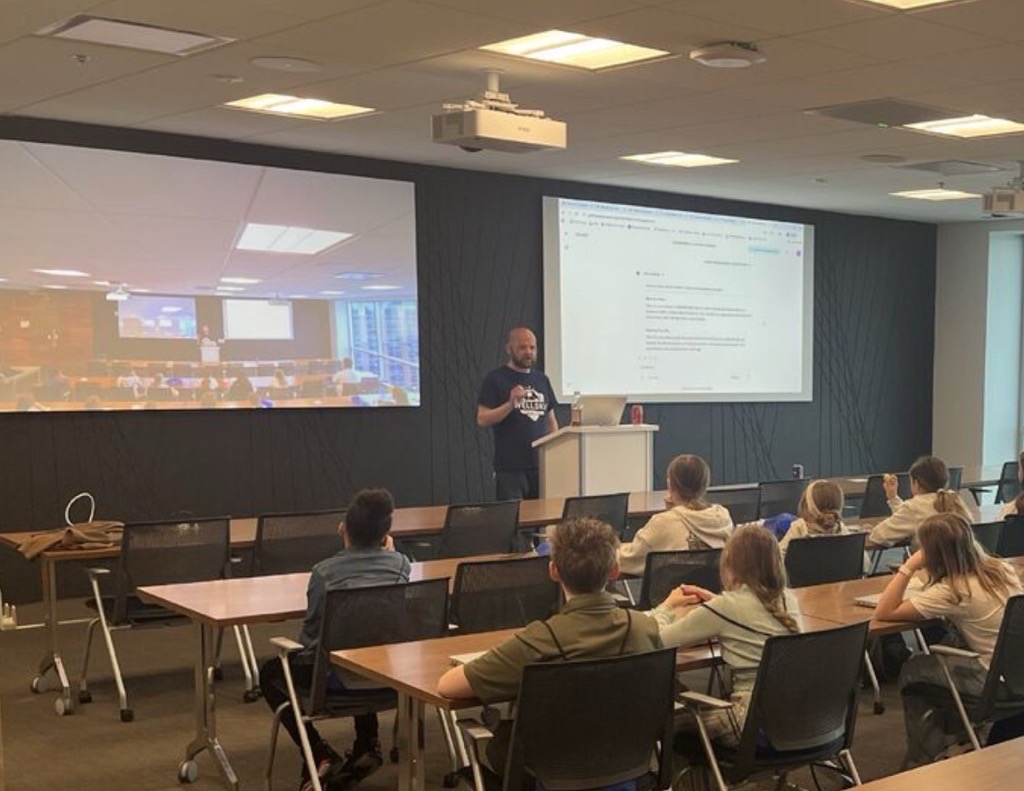
On April 23, WellSky’s Overland Park headquarters was a little louder than usual.
For Take Your Child to Work Day, we welcomed the children of WellSky teammates to WHQ. Thanks to an idea led and brought to life by Patrick Herrington, a staff software engineer on WellSky’s AI Center of Excellence team, we offered something different than the standard office tour: a sixty-minute, hands-on AI session called AI: The Hour Show.
The goal wasn’t just to show what AI can do, but to help kids understand how it works, where it breaks, and why people must stay actively involved when using it.
The session ran in four acts.
We began with live demos using Claude.ai to show how AI can generate a song in seconds, create a story from three random words, and even build working software. Before every demo, we paused and asked the room to predict what would happen next. That moment of prediction shifted the kids from passive observers to active AI testers, encouraging curiosity and critical thinking rather than blind trust.
In act two, the kids had 20 minutes to build something of their own: a story, a song, a game idea, or a short film pitch. The only rule was that they had to change at least three things the AI produced. This reinforced an important lesson: AI is a starting point, not the final answer. At the end, kids proudly demoed their creations, highlighting the human choices that made each one their own.
Act three intentionally flipped the narrative. The kids were challenged to make AI fail — specifically, to get it to confidently state something untrue. Through experimentation, they succeeded. AI invented books that didn’t exist, presented one-sided arguments, and confidently confirmed information that wasn’t grounded in reality. Together, the group discussed why this happens and what it means.
This was one of the most important moments of the hour. Kids didn’t just see that AI can be wrong – they learned why human oversight is essential to evaluate, guide, and validate AI outputs.
The session closed with a shared understanding: AI can be powerful and creative, but it must always be verified, validated, and guided by people. Kids left knowing not just how to interact with AI, but how to question it and when not to rely on it. Each child took home a creation story card capturing what they asked for, what AI gave them, what they changed, and what they learned along the way.
It was a meaningful moment for WHQ this year – and one we hope to make a tradition in the years to come.
