


Most people treat a promotion as something that happens to them. A manager decides you’re ready, a cycle opens, a title changes. I want to make the case for the opposite. You can design your own growth, and the work is more concrete than it looks.
I will not claim special authority. But I have leaned on this framework across the last decade or so, on my teams and on myself, and it has worked 18 times out of 20. The two it did not carry, (one of them my own), taught me as much as the wins.
Start with the Peter Principle
Most people know the Peter Principle as a joke. If Peter likes you, you get promoted. The real version is more useful. Organizations keep moving their best performers up a level until each one lands in a role where they are no longer exceptional, just OK, and there they stall. Scale that across a company and most people end up merely adequate at the jobs they hold.
The takeaway is simple. Being excellent at your current job should not earn your next one. Showing you can already be excellent at the next job should. Amazon makes that a usable test, called raising the bar: can the person perform at the 51st percentile or higher among the people already doing that target job today? Hold on to that number – it decides everything that follows.
Step 1: Align expectations
You cannot clear a bar you have not defined. Write down the competencies for your role, the specific things your leadership expects, and what good looks like for each. My own matrix for solutions runs to 25, but the method copies cleanly into engineering, marketing, or any function. If no such matrix exists, and it usually does not, draft it yourself (you can use the industry or the original job description) and put it in front of your manager with one question: is this the right picture of what my job, and my next job, require? Now you are both on the record about where the bar sits.
Step 2: Calibrate against two bars
Calibration makes the qualitative trackable. Rate yourself 1 to 5 on each competency, noting the context and who could vouch for it, then reconcile with your manager – that’s the key to avoiding mismatched expectations, and the most common source of frustration for growth and development.
The part most people miss is that you rate against two bars, not one.
What you rate against
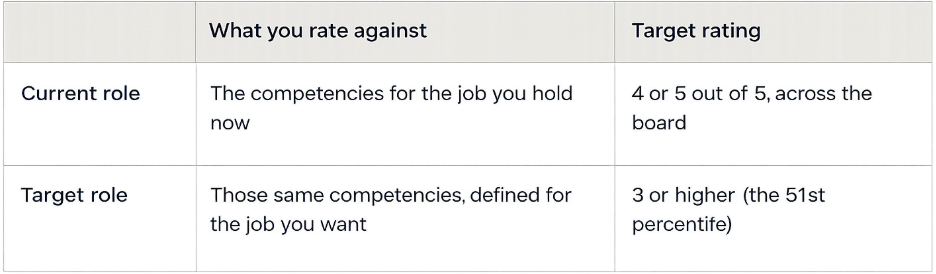
Master your current role first: anything at a 3 or below gets a joint action plan. For the target role, the bar is deliberately lower. You do not need a 5 in the job you want; you need a 3, because a 3 is the 51st percentile. Be excellent at the job you have, and credibly above the median at the one you want.
Matrix Sample:

Step 3: Document the case
When your current role sits at 4s and 5s and your target role at 3 and above, write the case. Every promotion on my teams is backed by a short document that answers four questions:
- Goal. You are recommending a promotion from X to Y.
- Support. Who is in the “we,” usually your manager, your skip level, and the stakeholders who can back it.
- Evidence. The specific initiatives where you demonstrated each competency.
- Data. The ratings themselves, for example a composite of 4.6 out of 5 across 25 dimensions, already at or above the 51st percentile for the target role.
Now you arrive at the conversation with evidence instead of a feeling.
Make it a habit, not an event
This works as a cadence, not a one-time push:
- Quarterly development meetings, separate from your one on ones, focused only on the matrix and your action plans.
- Skip level reviews once or twice a year, so your manager’s manager tracks the same story.
- Constant recalibration, with real-time feedback rather than an annual surprise.
The part nobody tells you
Early in my career I ran this playbook on myself, made my case, and did not get the promotion. It set me back six months. A manager told me something I still use: careers are not won or lost in a single window. What matters is the trend line over time, the regression –, not any one point on it.
There is a corollary. The higher you climb, the longer the gaps between promotions get, and rushing to clear one early just lands you in the next waiting room sooner. More importantly, invest in the capabilities that compound, and be honest about where you actually want to go. Careers are long, and 15 or 20 years out, an extra six or twelve months of waiting washes out, but whether you built the actual skill does not.
You don’t need permission to start. Managers want to develop their teams but are stretched thin, and the teammate who shows up with a drafted matrix, an honest self-assessment, and a clear view of the bar has already done the hardest part. Turn the vague career conversation into a concrete one, then keep having it. If a sample matrix or a redacted promotion document would help, reach out and I will share both.
